



| NATIONAL WATERWAY (NW-1) |
|---|
The Ganga - Bhagirathi - Hooghly river system between Haldia (Sagar) and Prayagraj (1620 km) was declared as National Waterway-1 (NW-1) in 1986. Since then IWAI is carrying out various developmental works on the waterway for improvement of its navigability and also development and maintenance of other infrastructure such as navigation aids and terminal facilities as laid down in the IWAI Act, 1985 (82 of 1985).
To augment the capacity of National Waterway-1 (from Haldia to Varanasi 1390 Kilometer stretch), Jal Marg Vikas Project (JMVP) is being implemented with technical and financial support of the World Bank. The Jal Marg Vikas Project on NW-1 from Haldia to Varanasi was approved by the CCEA on 3rd January, 2018 at a cost of Rs. 5369.18 crore (US$ 800.00 million). The loan agreement with the World Bank was signed on 2nd February, 2018. The project cost has been revised to Rs. 5061.15 cr. The project is expected to be completed in December 2025.
The development objective of JMVP is to enhance transport efficiency and reliability of NW-1. The project comprises of several components viz. development of multimodal terminals at Varanasi, Sahibganj and Haldia; intermodal terminal at Kalughat; fairway development/ maintenance (Haldia to Barh-3m, Barh to Ghazipur – 2.5m and Ghazipur to Varanasi – 2.2m); navigational facilities (Channel marking, Day/Night Navigational Aids, River Information System etc.); Community jetties (Uttar Pradesh – 15, Bihar – 20, Jharkhand – 3, West Bengal – 22); New navigational lock at Farakka, Modernization of existing navigational lock at Farakka; Quick Pontoon Opening System etc.
| Terminals |
|---|
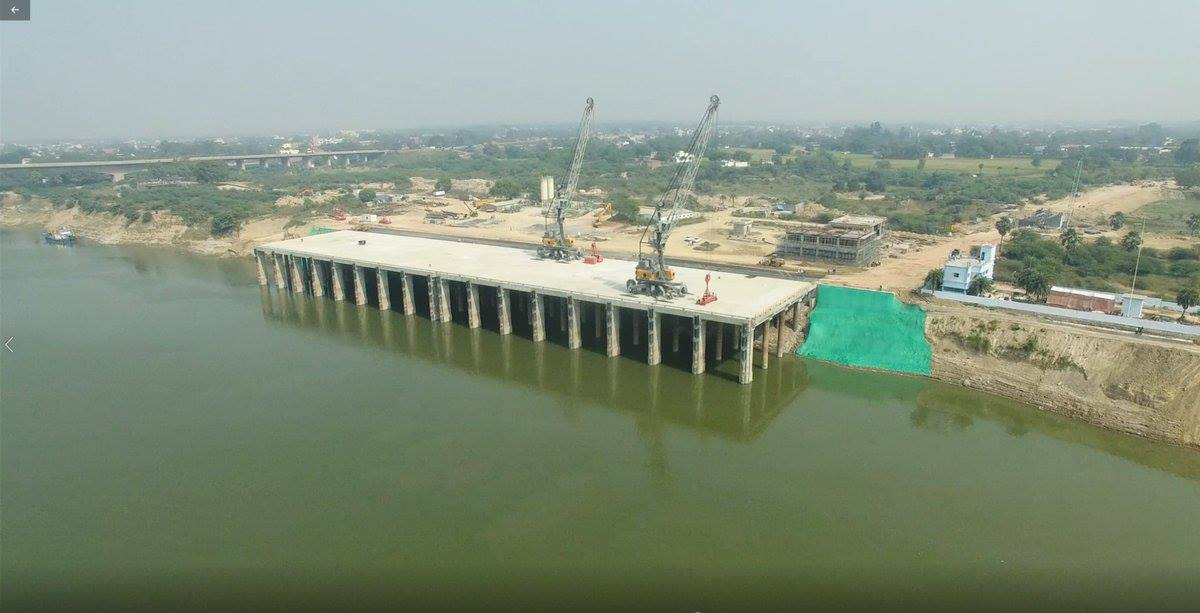 The Inland Waterways Authority of India (IWAI) develops and manages terminals along National Waterways to support cargo handling, passenger movement, and multimodal logistics integration. These terminals facilitate efficient loading, unloading, storage, and transfer of freight and passengers between inland vessels, road, and rail networks.
IWAI terminals are planned and executed with appropriate cargo handling equipment, passenger amenities, and connectivity infrastructure to enhance operational efficiency and promote inland water transport as a competitive and sustainable mode of freight and passenger movement. The development of terminals contributes to improved supply chain connectivity, reduced logistics costs, and expanded economic opportunities along the waterways.
| S. No. | Terminal Type | Capacity | Terminal Location | Waterway | Major Commodities |
| 1 | Multimodal | 1.26 MTPA | Varanasi, Uttar Pradesh | NW–1 (Ganga) | Containers, construction materials, food grains, edible oil, fertilizers, bulk cargo |
| 2 | Intermodal Container | 77,000 TEU/year | Kalughat, Bihar | NW–1 (Ganga) | Containerized cargo |
| 3 | Multimodal | 3.03 MTPA | Sahibganj, Jharkhand | NW–1 (Ganga) | Bulk cargo, coal, stone chips |
| 4 | Multimodal | 3.08 MTPA | Haldia, West Bengal | NW–1 (Ganga) | Containers, fly ash, fertilizers, edible oil |
| Navigational Locks |
|---|
The new Navigational Lock at Farakka has been constructed over 14.86 hectares as part of the Farakka Barrage Project at a cost of ₹359.19 crore. It became operational after successful vessel testing on 31 March 2023.
The earlier lock gate was handed over to IWAI in April 2018 by Farakka Barrage Project and is being upgraded under the Jal Marg Vikas Project (JMVP–II). Once all works are completed, the lock system will allow vessels to move smoothly in both directions across the Farakka Barrage, improving inland water transport and connectivity.
| Farakka Navigational Lock | |
| National Waterway | NW-1 (Ganga) |
| Location | Farakka, West Bengal |
| Project Cost | ₹359.19 crore |
| Executing Agency | IWAI |
| Status | Operational (March 2023) |
| Key Features & Technology | 1. Automated Operation: Uses an electromechanical hydraulic system with remote control from a central control room. 2. Types of Gates: Includes miter gates (two leaves hinged on a vertical axis), radial gates, and bulkhead/caisson gates. 3. Dimensions: The Farakka lock is large, with an internal length of ~180m, width of ~25m, and depth of ~13m. 4. Efficiency: Reduces vessel crossing time dramatically (e.g., Farakka reduced from 2 hours to ~23-30 minutes). 5. Connectivity: Enhances trade on NW-1, connecting to NW-2, NW-26, and the Indo-Bangladesh Protocol Route. |
| Fairway Development |
|---|
Fairway development works include improvement and maintenance of river fairway aimed at reducing the transit time and increasing the reliability of the usage of waterways. The fairway development components include, river conservancy works, design and development of mechanization of pontoon bridge opening to facilitate faster and sustainable movement of vessels.
| S.No. | Stretch | Least Available Depth (LAD) | Status |
| 1 | Haldia Access Channel | 3 m | Under Implementation |
| 2 | Tribeni - Katwa | 3 m | Under Implementation |
| 3 | Katwa - Farakka | 3 m | Under Implementation |
| 4 | Farakka - Kalhalgaon | 3 m | Fairway Maintenance works- Ongoing |
| 5 | Sultanganj – Mahendrapur | 3 m | Fairway Maintenance works- Ongoing |
| 6 | Mahendrapur - Barh | 2.5 m | Fairway Maintenance works- Ongoing |
| 7 | Barh – Digha | 2.5 m | Under Implementation |
| 8 | Kalughat Access Channel | 2.5 m | Under Implementation |
| 9 | Digha – Majhua | 2.5 m | Fairway Maintenance works- Ongoing |
| 10 | Majhua – Ghazipur | 2.5 m | Under Implementation |
| 11 | Ghazipur – Varanasi | 2.2 m | Under Implementation |