
| Jetty / Pontoon |
|---|
Development and modernization of Community Jetties:
The development and modernization of 60 nos. of community jetties along the river Ganga is being undertaken to boost economic activities at the community level. This development along the river Ganga in four states will improve facilities for the commuters and also bring down the logistics cost for farmers in the movement of local produce the community jetties are spread across the states of Uttar Pradesh, Bihar, Jharkhand and West Bengal as mentioned in the table below:
| Name of the State | Community Jetties |
| Uttar Pradesh | 15 |
| Bihar & Jharkhand | 23 |
| West Bengal | 22 |
| Total | 60 |
The development of the community jetties includes offshore floating jetties and onshore terminal facilities.
Offshore Floating Jetties: The offshore floating jetties are located in the river and anchored/moored with a suitable arrangement to the riverbank. The offshore floating jetties comprise of a floating pontoon of suitable material and a gangway connecting the pontoon to the onshore area/terminal. The vessels can berth at the floating jetty and the passengers can safely embark or disembark the vessel and reach the onshore terminal area via the gangway. Currently, 11 jetties in Uttar Pradesh have been completed. In Bihar & Jharkhand 21 jetties have been completed and balance works for 2 jetties are in progress. In West Bengal, 5 jetties have been completed and balance works for 11 jetties are in progress.
Onshore Terminal Facilities: The onshore facilities include a terminal developed on suitable land parcel adjacent to the offshore floating jetty. It shall have facilities such as waiting area, ticketing room, security office, administrative office space, pantry space, storage space, public toilets, parking area based on location and site requirements. The terminal will be accessible by adequate road and required electricity supply, water supply and wastewater disposal system.
| Vessels and Dredgers |
|---|
The Inland Waterways Authority of India (IWAI) operates vessels and dredgers to support the development, maintenance, and safe operation of National Waterways. These assets are used to ensure navigable channels, maintain required depths, and facilitate the movement of inland water transport vessels.
IWAI vessels are deployed for hydrographic surveys, channel marking, river conservancy, and monitoring of navigation conditions. Dredgers are used for capital and maintenance dredging to remove shoals, improve channel geometry, and maintain assured depths as per approved waterway development plans.
The deployment of IWAI vessels and dredgers contributes to improved inland waterway connectivity, safe navigation, and reliable cargo and passenger movement, supporting the Government of India’s objectives for efficient and sustainable inland water transport.
| Ship Repair Facilities |
|---|
The Inland Waterways Authority of India (IWAI), under the Ministry of Ports, Shipping and Waterways, has developed dedicated Ship Repair Facilities (SRFs) along National Waterway-1 (NW-1) to strengthen inland water transport operations on the River Ganga. These facilities are strategically located to provide essential maintenance, repair, and overhaul services for cargo vessels, passenger ferries, and inland waterway crafts operating on the Haldia–Varanasi stretch.
The Ship Repair Facilities at Patna (Bihar) and Varanasi (Uttar Pradesh) address a critical infrastructure gap by enabling local repair and dry-docking services that were earlier available only at distant coastal shipyards. By reducing vessel downtime and operational costs, these facilities enhance service reliability, safety, and efficiency on NW-1, in line with the objectives of the Maritime Amrit Kaal Vision 2047.
Designed with modern workshops, dry docks, and eco-friendly systems, the SRFs support sustainable inland navigation while contributing to regional economic development, employment generation, and improved logistics performance across the National Waterway-1 corridor.
Major Key Features – Ship Repair Facilities on NW-1
| Location | Current Status | Core Facilities | Repair Capacity | Workshop Infrastructure | Vessel Types Supported | Strategic Integration | Economic Impact | Policy Alignment |
| Patna, Bihar | Operationalization initiated; afloat repair services active; EPC finalized (2025) | Dry docks, slipways, repair yards | Maintenance, repair, and overhaul of inland vessels | Engine overhaul, steel fabrication, marine electrical and propeller repair workshops | Cargo vessels, passenger vessels, inland crafts | Supports uninterrupted cargo and passenger movement on NW-1 | Reduced downtime and operational costs; regional employment generation | Maritime Amrit Kaal Vision 2047, Atmanirbhar Bharat |
| Ramnagar, Varanasi (near the MMT) | Under EPC phase; tenders issued (2025–26) | India’s first dry-dock on River Ganga, slipways | Simultaneous repair of up to four vessels | Specialized workshops with modern machinery | Cargo barges, passenger ferries, electric & hybrid vessels | Integrated with Freight Village and multimodal logistics hub | ~50% reduction in repair costs; large-scale employment generation | Maritime Amrit Kaal Vision 2047, Harit Nauka Guidelines |
| Cargo Movements |
|---|
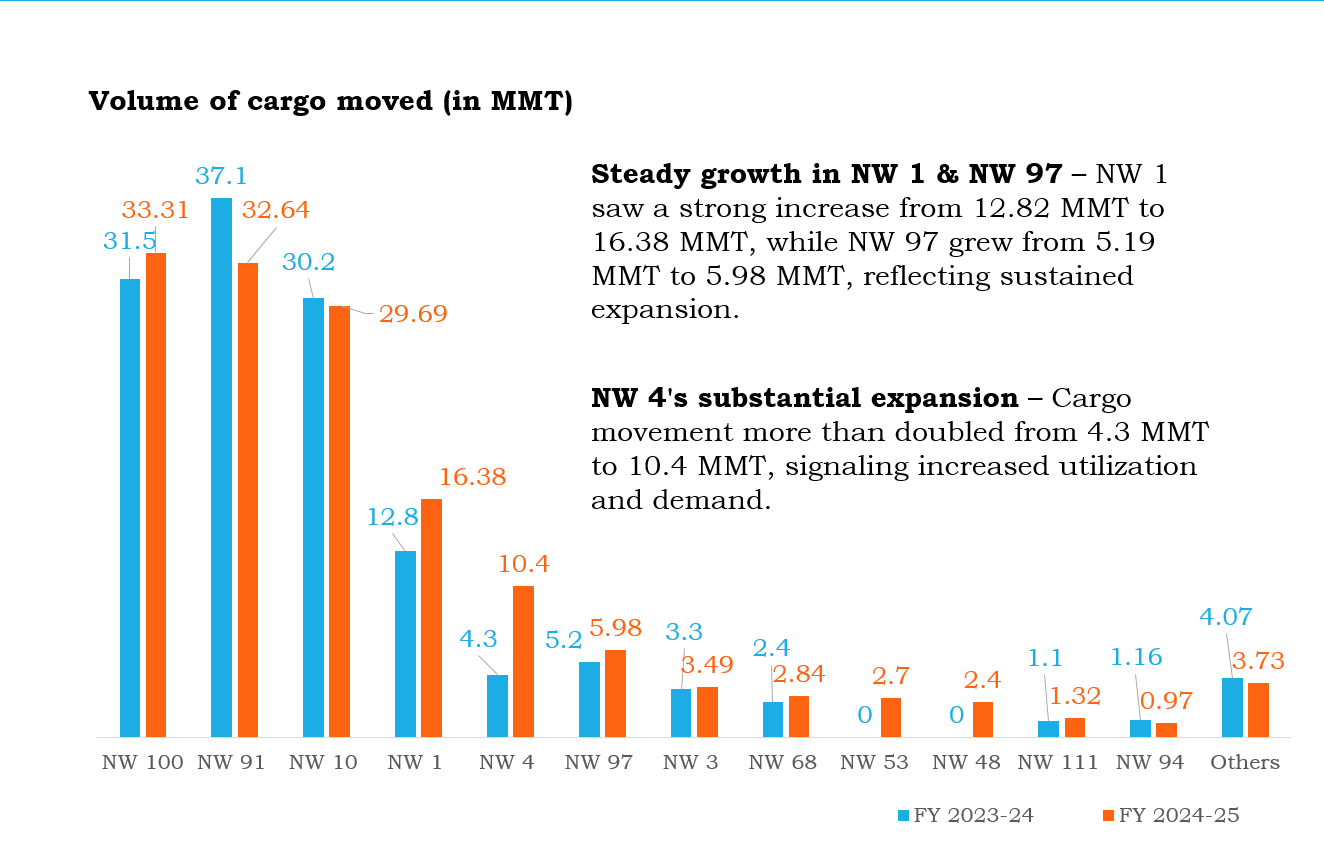
Cargo traffic on National Waterways registered encouraging trends during FY 2024–25, reflecting progressive improvement in infrastructure, operational efficiency, and modal shift towards inland water transport.
Significant growth was observed on National Waterway–1 (NW-1), where cargo movement increased from 12.82 Million Metric Tonnes (MMT) in FY 2023–24 to 16.38 MMT in FY 2024–25, indicating enhanced utilization of the Ganga waterway and associated terminals.
National Waterway–4 (NW-4) recorded a substantial expansion, with cargo volumes more than doubling from 4.30 MMT to 10.40 MMT during the same period, reflecting increased demand and improved navigational capacity.
Steady growth was also noted on National Waterway–97 (NW-97), where cargo movement rose from 5.20 MMT in FY 2023–24 to 5.98 MMT in FY 2024–25, underscoring sustained operational momentum.
Cargo movement on established waterways such as NW-100, NW-91, and NW-10 remained robust, continuing to contribute significantly to the overall cargo throughput. Additionally, commencement of cargo operations on NW-53 and NW-48 during FY 2024–25 marked further expansion of the inland waterways network.
Overall, the increase in cargo volumes across multiple National Waterways demonstrates the growing role of inland water transport as a reliable, economical, and environmentally sustainable mode of transportation in the country.